Thyroid Cancer
About 5 percent of thyroid disorders can be malignant. These generally present in form thyroid enlargement. Thyroid cancers can be of various types. Commonest amongst all is Papillary carcinoma of thyroid. Other cancers can be Follicular carcinoma, Medullary carcinoma, Anaplastic carcinoma, Lymphoma etc.
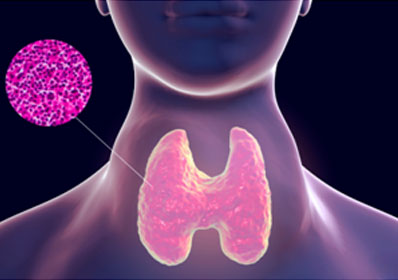
● Thyroid Lymphoma
- Extremely rare cancer arising from immune cells within the thyroid.
- Often associated with pre-existing Hashimoto’s thyroiditis.
- Treated primarily with chemotherapy and radiation rather than surgery.
- In patients whose tumours carry a BRAF mutation, targeted therapy (BRAF/MEK inhibitors) has improved outcomes.
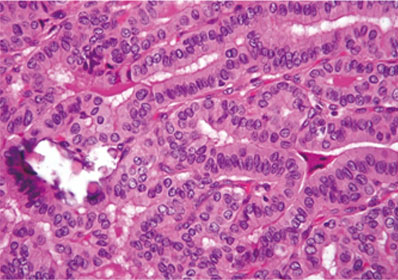
● Papillary Thyroid Carcinoma
- Most common type of thyroid cancer, 80-85% of all cases
- Excellent prognosis
- May spread to lymph nodes
- May be linked to radiation exposure in childhood
- May have a few aggressive variants – tall cell, diffuse sclerosing, etc.
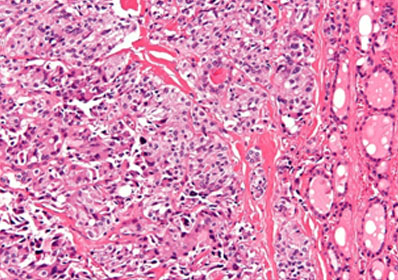
● Medullary Thyroid Carcinoma
- Arises from C-cells of the thyroid (not from usual thyroid cells).
- Can occur spontaneously or run in families (genetic).
- Requires specialized evaluation due to possible genetic association (RET gene).
- May cause diarrhoea or facial flushing due to hormone secretion
- In hereditary cases, can occur along with adrenal tumours (MEN2 syndrome)
- Advanced cases may benefit from targeted therapies such as RET inhibitors (e.g., selpercatinib)
- Treatment is mainly surgery; radioactive iodine is not effective for this type.
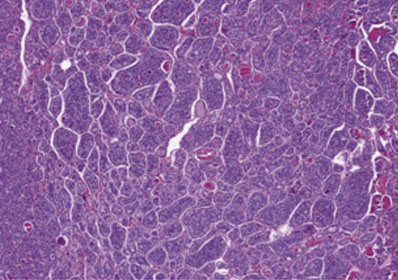
● Poorly Differentiated Thyroid Cancer (PDTC)
- A rare cancer that is biologically between well-differentiated (PTC/FTC) and anaplastic cancer.
- Faster-growing mass compared to PTC/FTC
- Often shows earlier spread to lymph nodes or distant organs
- May present with hoarseness, difficulty swallowing, or rapid enlargement of the thyroid
- Prognosis Intermediate: more aggressive than PTC/FTC, but better outcomes than anaplastic cancer
- RAI response varies; many patients require surgery plus systemic or targeted therapies.
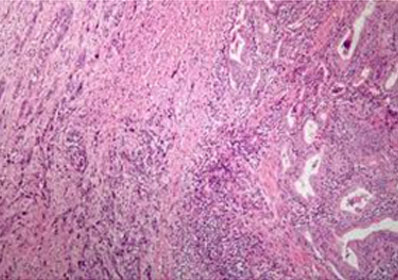
● Anaplastic Thyroid Carcinoma
- Very rare (2%) but very aggressive.
- Usually affects older adults.
- Needs urgent, team-based care including surgery, radiation and chemotherapy.
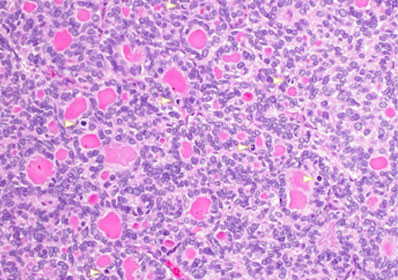
● Follicular Thyroid Carcinoma
- Second most common type
- Spread through blood vessels – may spread to bones
- Seen in areas with low iodine intake
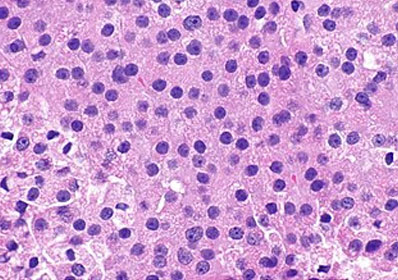
● Hurthle Cell Carcinoma
- A subtype of follicular cancer but behaves slightly more aggressively.
- Less likely to take up radioactive iodine.